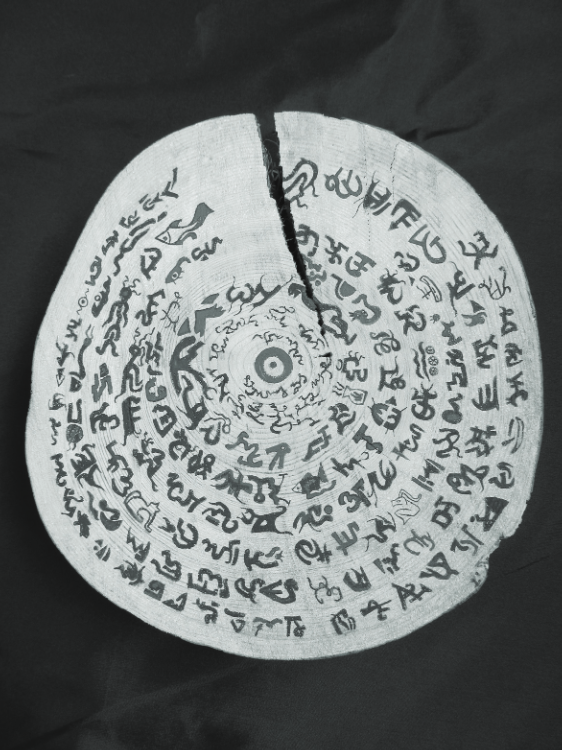
TEXT INSTEAD OF LANGUAGE: ASEMIC WRITING IN THE 1990s - 2010s ART
Keywords:
Asemic writing; unreadable texts; amateur art; contemporary art; non-linguistic communication.Abstract
The author studied a little-known phenomenon in the art of recent decades, located on the border of literary and visual creativity – “asemic writing”. It belongs to one of those trends that develop on the periphery of artistic life and are often ignored in art studies. The authors who create asemic works seek to “erase” the language and find new ways of non-linguistic communication. Their work must be radically open to interpretation, but at the same time use the form of writing and refer to its rules. The works of representatives of this trend are closest to the experiments of the lettrists – artists of the French avant-garde movement in the mid-20th century. In the 1990s Tim Geyse and Jim Leftwich founded the movement of “asemic writing”, which was joined by authors from different parts of the world: tens or even hundreds of people (it is not possible to calculate their exact number due to the specifics of the phenomenon itself). The focus of the study was on the conceptual foundations of asemic writing and only to a small extent on the formal analysis of works. Asemic writing is regarded as an intermedial art that has made a gradual transition from the verbal realm to the purely pictorial one. The article touches on such features of this trend as openness to the world community, indifference to cultural institutions, orientation towards distribution in the Internet environment, marginality and artistic ambiguity, demonstrative rejection of professionalism, the actionist orientation of the phenomenon itself, and the desire of asemic authors to transform reality towards lesser violence.
References
Anthrolethargy: an art and theory blog (2016) The Indeterminacy of Meaning: Asemic Writing and (non) Sens [Online]. Available at: https://anthrolethargyajournal.wordpress.com/2016/06/22/the-indeterminacy-of-meaning-asemic-writing-and-non-sens/ (accessed: 19 July 22).
Asemic magazine (no date) Asemic [Online]. Available at: http://www.asemic.net/ (accessed: 19 July 22).
Basin, E. Ia. (1999) Iskusstvo i kommunikatciia (ocherki iz istorii filosofsko-esteticheskoi mysli) [Art and Communication (Essays from the History of Philosophical and Aesthetic Thought)]. Moscow: MONFPubl. (in Russian)
Foster, H., Krauss, R., Bois, Y.-A., Buchloh, D., Joselit, D. (2005) Art Since 1900 : Modernism, Antimodernismm Postmodernism. London: Thames & Hudson.
Gaze, T. (2009) ‘Hypotheses’, Slova [The words], 6, p. 64. (in Russian)
Hofmann, W. (2002) Die Grundlagen der modernen Kunst. Eine Einführung in ihre symbolischen Formen. Stuttgart: Kroener Alfred GmbH + Co (in German)
Jacobson, M., Gaze, T. (2013) An Anthology of Asemic Handwriting. NY: Punctum books.
Kolomietc, G. G. (2013) ‘One Hundred Scenes of Writing (review of Tim Geise's 100 Scenes)’, Slova [The words], 12, p. 60-61. (in Russian)
Kolomietc, G. G., Shiro, D. (2009) ‘Anarcheology: An Interview with David Shiro’, Slova [The words], 7, p. 6-8. (in Russian)
Lingvisticheskii entciklopedicheskii slovar [Linguistic Encyclopedic Dictionary] (1990) Moscow:Soviet Encyclopedia Publ. (in Russian)
Prokhorova, L. P., Anikeeva, E. S. (2008) ‘Visual poetry as a special genre’, Vestnik KemGU [Bulletin of the Kemerovo State University], 2, p. 169-174. (in Russian)
Samigulina, E. A. (2015) ‘To the question of the nature of asemic writing’, Repozitorii BGPU: sb. rabot molodykh uchenykh [Repository of the Belarusian State Pedagogical University: a collection of works by young scientists]. Available at: URL: https://elib.bspu.by/handle/doc/6039 (accessed: 19 July 22). (in Russian)
Schwenger, P. (2019) Asemic: The Art of Writing. Minneapolis: University of Minnesota Press.
Slova magazine website (2014) Interview with Michael Jacobson [Online]. Available at: http://slova.name/blog/interviu-s-mayklom-dzheykobsonom.html (accessed: 19 July 22). (in Russian)
Verina, U. Iu. (2018) ‘Marginality of the asemic writing: between the graphic and poetry, language and sense, art and politics’, Uralskii filologicheskii vestnik. Seriia: Russkaia literatura XX-XXI vekov: napravleniia i techeniia [Ural Philological Bulletin. Series: Russian Literature of the 20th-21st Centuries: Directions and Currents], 3, p. 105-113. (in Russian)
Winston, C. N., Mogrelia, N., Maher, H. (2016) ‘The Therapeutic Value of Asemic Writing: A Qualitative Exploration’, Journal of Creativity in Mental Health, 11 (2), p. 142-156.